Buying a New-Build Home in 2026? The Checks That Could Save Buyers Thousands
A Data Menu Research desk review of the protections new-build buyers have in 2026: NHBC Buildmark cover, the updated New Homes Quality Code inspection, the New Homes Ombudsman Service, five checks before you complete, and published repair costs by trade.
Data Menu Research | 20 October 2026 | Desk review. This article is general information, not legal or financial advice.
A new-build home comes with more formal protection than most second-hand homes: a 10-year warranty on many new homes, an industry code for registered developers and an ombudsman service for complaints. But that protection depends on dates, paperwork and who the builder is. Miss the two-year builder warranty window, or skip the pre-completion inspection, and a buyer may be left paying to fix problems themselves.
The scale of the problem is debated. Snagging firm HomeSnag says the new-build homes it inspected had an average of 130 defects, based on data from 2,000 inspections it carried out in 2026, as reported by This is Money on 9 October 2026. That is HomeSnag's own figure from its own inspections, and we have not been able to check it independently (see the methodology section below).
This guide sets out how the main protections work, five checks to make before completion, and what common defects can cost to fix if nobody else pays.
How new-build warranty cover works: years 1-2 vs years 3-10
Most buyers will hear about NHBC Buildmark, which NHBC describes as its "10-year warranty and insurance" for newly built and newly converted homes for private sale. It is split into three sections:
- Before completion (Section 1). Between exchange of contracts and legal completion, Buildmark covers the loss of your deposit, or having to pay more to finish the build, if the builder becomes insolvent.
- Years 1-2: the builder warranty (Section 2). For the first two years from legal completion, NHBC says the builder, not NHBC, is responsible for putting right problems caused by the builder failing to meet NHBC requirements. NHBC guarantees the builder's obligations during this period.
- Years 3-10: NHBC insurance (Section 3). For the next eight years, NHBC provides insurance covering the cost of repairing damage caused by defects in specific parts of the home described in the policy, such as foundations not built to NHBC requirements.
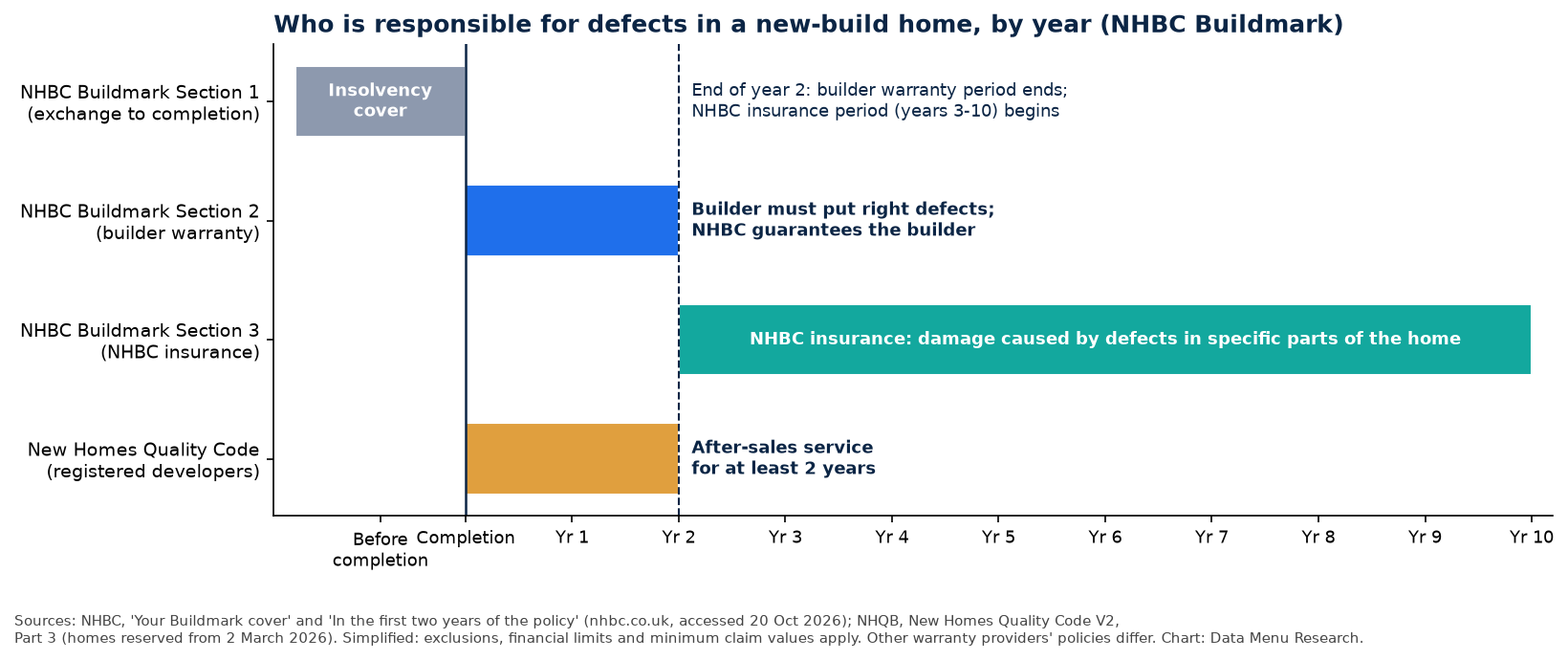
Source: NHBC Buildmark cover pages and NHQB New Homes Quality Code (Part 3), accessed 20 October 2026. Simplified; exclusions and financial limits apply.
The switch at the end of year two matters. NHBC lists what Buildmark does not cover, including wear and tear, gradual deterioration, neglect, alterations made after NHBC's final inspection, and items covered by other insurance or manufacturers' warranties. In years 3-10 a minimum claim value can also apply, and it is shown on your policy certificate. If your home has a warranty from a different provider, read that policy; the terms will not be identical.
The New Homes Quality Code and the pre-completion inspection
The New Homes Quality Code, run by the New Homes Quality Board (NHQB), sets out what registered developers must do before and after a sale. Version 2 of the Code applies to homes reserved from 2 March 2026; homes reserved before that date remain under version 1 (October 2023).
A buyer's right to a pre-completion inspection is not new. Version 1 already allowed buyers to appoint a suitably qualified inspector, within five days of the notice to complete. What version 2 changes, according to the Code text published by NHQB:
- The developer must give the buyer the chance to carry out the inspection themselves or to appoint a suitably qualified inspector.
- The inspection should take place after the notice to complete and before the completion date (or earlier if both sides agree).
- It must follow NHQB's standard Pre-Completion Inspection Checklist. Developers must tell buyers who inspect for themselves that the checklist was designed for professionals, so they may miss things.
- If the inspection finds issues that breach the warranty's technical standards, the developer is responsible for fixing them, ideally before legal completion or within 30 days if that is not possible.
The Code also says the notice to complete is usually expected to give at least 14 calendar days. That window is your chance to book the inspection.
The New Homes Ombudsman Service
Under Part 3 of the Code, a developer must provide an after-sales service for at least two years from completion and must have a complaints procedure. If a complaint is not resolved, it can be referred to the New Homes Ombudsman Service 56 days after the complaint start date. Buyers have two years from the date of reservation or completion, whichever is later, to complain and refer it to the Ombudsman.
The Ombudsman can only look at complaints about developers registered with it. You can check a builder on the NHQB Register of Developers before you reserve.
Five checks before you complete
1. Inspect the actual plot, not the show home
Show homes are often upgraded and dressed to sell. Ask to see your own plot, or a finished home of the same type, and check the plans and specification attached to your reservation agreement. Under the Code, if the developer makes a "major change" to the size, appearance or value of the home after you reserve, you can cancel within 14 days of being told in writing and get a full refund of your deposit and fees.
2. Verify the warranty and get the policy documents
Ask which warranty provider covers the home and when cover starts. NHBC says your conveyancer should provide the Buildmark policy booklet and certificate, and that the builder warranty period is usually two years from the start date shown on the certificate. If you are not the first owner, NHBC warns that earlier claims may already have used up some of the policy's financial limits.
3. Check the builder's complaints process (and register status)
Confirm the developer is on the NHQB register and ask for its complaints procedure in writing. Both the NHBC resolution service and the Ombudsman expect you to have gone through the builder's own process first.
4. Work out the full cost of ownership
The price is only part of the cost. For a leasehold home, the GOV.UK guide to buying a leasehold home suggests asking about ground rent and how it increases, service charges and what they cover, administration and permission fees, and whether the freeholder plans to sell the freehold (especially for new builds). For most new long leases granted since 30 June 2022, the Leasehold Reform (Ground Rent) Act 2022 limits ground rent to a "peppercorn", so a new lease asking for money as ground rent is worth questioning with your solicitor. For a freehold house on a managed estate, ask in writing about any estate or management charges for roads, green spaces and other shared areas.
5. Compare incentives with the home's value
Incentives such as paid deposits, free extras or contributions to fees can be useful. But the price should still make sense next to comparable homes nearby. Ask your mortgage lender and surveyor how incentives are treated in the valuation before you commit.
Data Menu model: what the first two years can cost
This is an illustrative MODEL, not a survey, and not a prediction of any buyer's actual costs or defects. To show how the main recurring costs and developer incentives compare, we built a simple, reproducible model of the first two years of owning a new build: the length of NHBC's builder warranty period and of a 2-year fixed-rate mortgage. Every scenario uses the same price and mortgage, so the differences come only from charges and incentives.
All three scenarios assume a price of £369,759 (the HM Land Registry UK House Price Index average for a new build, May 2026), a 10% deposit and a 90% mortgage at 5.37% (the Bank of England's average quoted rate for a 2-year fix at 90% loan-to-value, September 2026), repaid over 25 years. That gives a monthly payment of £2,018, or £48,428 over 24 months, of which £35,066 is interest.
| Scenario | Mortgage payments (24 months) | of which interest | Service/estate charges (2 yrs) | Snagging inspection | Incentives received | Two-year costs minus incentives |
|---|---|---|---|---|---|---|
| A. Freehold house, with incentives (5% deposit contribution + legal fees paid) | £48,428 | £35,066 | £400-£1,000 | £366-£480 | £19,488-£20,488 | £28,706-£30,420 |
| B. Freehold house, no incentives | £48,428 | £35,066 | £400-£1,000 | £366-£480 | £0 | £49,194-£49,908 |
| C. Leasehold flat (under 11m to 11-18m block), with incentives | £48,428 | £35,066 | £4,836-£7,014 | £366-£480 | £19,488-£20,488 | £33,142-£36,434 |
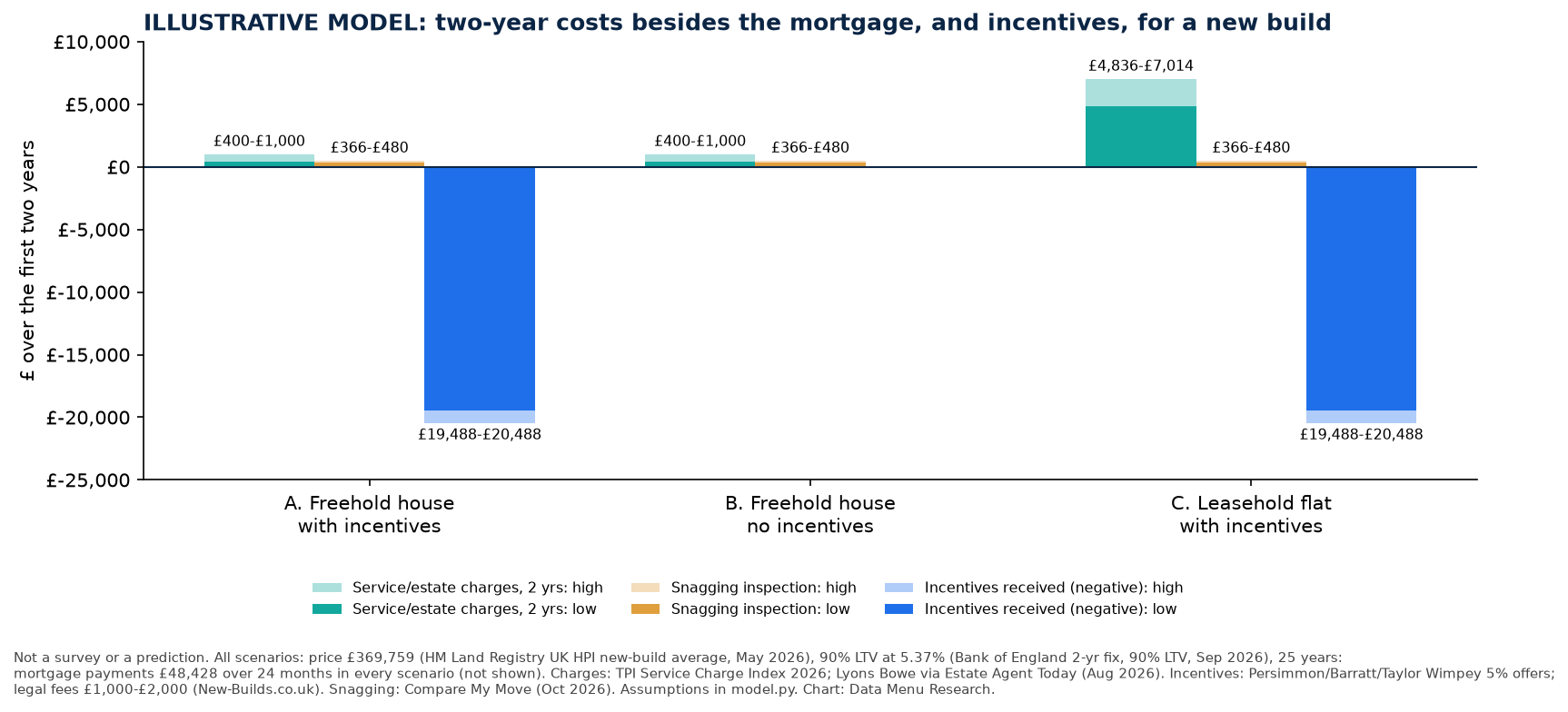
Illustrative model by Data Menu Research. Sources and assumptions are listed below; the calculations are in a reproducible script.
What the model suggests:
- In our illustrative model of a £369,759 new-build flat, developer incentives worth £19,488-£20,488 (a 5% deposit contribution plus legal fees) were larger than two years of service charges, which came to £4,836-£7,014.
- In our model, a buyer with a 90% mortgage at 5.37% (the Bank of England's average quoted rate for a 2-year fix at 90% LTV, September 2026) would pay £48,428 in mortgage payments over the two-year fix, of which £35,066 (72%) is interest - more than 5 times the highest two-year service charge in the model.
Incentives are not free money. A deposit contribution reduces the cash you need, but the price, your lender's treatment of the incentive and the home's valuation all matter (see check 5 above). The Property Institute's index shows average service charges rose 5.8% between 2024 and 2026; this model holds them flat.
Model methodology: assumptions and sources
- Price: £369,759, UK new-build average price for May 2026 (HM Land Registry UK HPI, July 2026 data file; new-build figures are provisional and revised).
- Mortgage rate: 5.37%, Bank of England series IUMB482, quoted 2-year fixed rate at 90% LTV, September 2026.
- Deposit 10% / 90% loan-to-value: our assumption, matched to the rate series.
- Term 25 years, capital repayment, rate fixed for all 24 months: our assumption.
- Same price for the house and the flat: our assumption (the UK HPI new-build series we used is not split by property type).
- Flat service charge £2,418-£3,507 a year: The Property Institute Service Charge Index 2026 (2026 budgets), average for buildings under 11m and 11-18m tall. The choice of these two bands is our assumption.
- Freehold estate charge £200-£500 a year: Lyons Bowe solicitors, reported by Estate Agent Today, August 2026 (the CMA's average of £358 a year, cited by MHCLG, falls inside this range).
- Deposit contribution 5% of the price: the published offer terms of Persimmon (Wessex, June-August 2026), Barratt ("Deposit Boost") and Taylor Wimpey ("Deposit Top-Up"). We assume it tops up a 5% buyer deposit to 10%, so the mortgage is unchanged: our assumption.
- Legal fees paid £1,000-£2,000: New-Builds.co.uk buyer guide (a secondary source; developers do not publish a fixed amount).
- Snagging inspection £366-£480: Compare My Move snagging survey cost guide, updated 14 October 2026.
- Ground rent £0 (a peppercorn under the Leasehold Reform (Ground Rent) Act 2022): our assumption.
- No defects costed: our assumption, because defects reported in years 1-2 should be put right by the builder under the builder warranty.
- Charges held flat, with no inflation; stamp duty, insurance, council tax, utilities and moving costs left out; price not inflated to fund incentives: our assumptions.
- Ranges: the low case pairs the lowest costs with the highest incentives, and the high case does the reverse.
Document every defect
Snagging problems are easier to resolve with a paper trail. NHBC advises contacting the builder as soon as you reasonably can, and always within the builder warranty period, keeping a record of what you said, who you spoke to and when. NHBC also publishes template letters for reporting issues, making a formal complaint and chasing a reply.
Our practical suggestions: photograph each issue with the date, keep one running list, report in writing (email is fine), and keep the developer's replies together. Professional snaggers often use specialist kit; HomeSnag, for example, says it uses thermal cameras to check insulation and heating.
What defects can cost to fix
If a defect is found too late, or isn't covered, the bill can fall on the owner. The ranges below are published by Checkatrade in its UK cost guides. They are ballpark figures, not quotes, and the price of any real job will depend on the home and the trade.
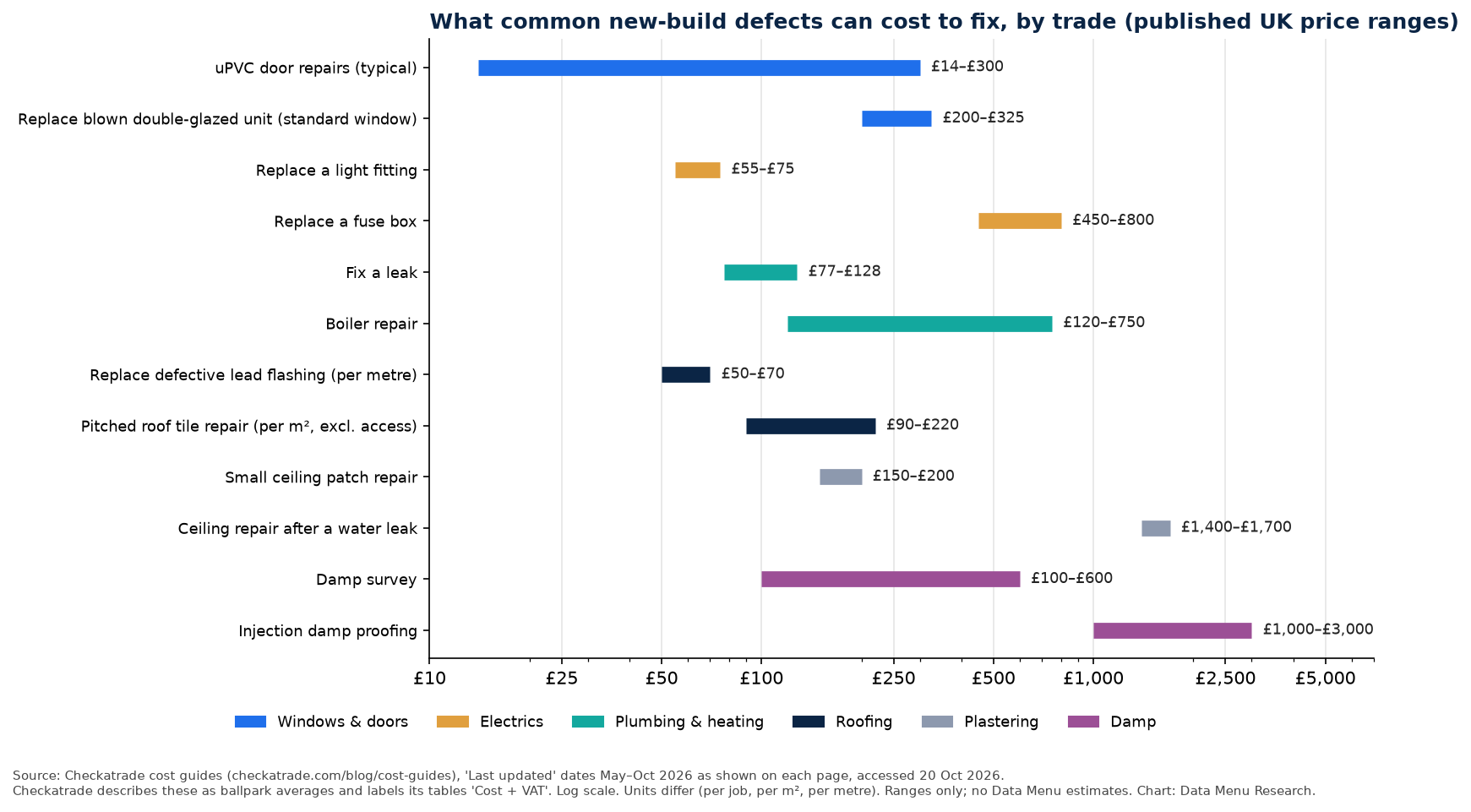
Source: Checkatrade cost guides, "Last updated" May to October 2026 as shown on each page, accessed 20 October 2026. Checkatrade labels its tables "Cost + VAT". Units differ: per job, per m² or per metre.
| Trade | Job (as described by Checkatrade) | Published range | Page last updated |
|---|---|---|---|
| Windows and doors | uPVC door repairs (typical) | £14-£300 | July 2026 |
| Windows and doors | Replace a blown double-glazed unit, standard window | £200-£325 | June 2026 |
| Electrics | Replace a light fitting | £55-£75 | May 2026 |
| Electrics | Replace a fuse box | £450-£800 | May 2026 |
| Plumbing and heating | Fix a leak | £77-£128 | June 2026 |
| Plumbing and heating | Boiler repair | £120-£750 | October 2026 |
| Roofing | Replace defective lead flashing (per metre) | £50-£70 | June 2026 |
| Roofing | Pitched roof tile repair (per m², excluding access) | £90-£220 | June 2026 |
| Plastering | Small ceiling patch repair | £150-£200 | June 2026 |
| Plastering | Ceiling repair after a water leak | £1,400-£1,700 | June 2026 |
| Damp | Damp survey | £100-£600 | June 2026 |
| Damp | Injection damp proofing | £1,000-£3,000 | June 2026 |
When choosing a trade for work that falls to you, the official registers are a good place to start: FENSA's installer search for replacement windows and doors (FENSA also lets homeowners request a copy of a FENSA certificate), TrustMark's find-a-tradesperson search, and the MCS find-an-installer tool for solar panels, heat pumps and other small-scale renewables.
If the builder doesn't put things right: NHBC's resolution service
For Buildmark homes, NHBC's resolution service may help with disputes during the builder warranty period. NHBC says that before you ask for it, you must have:
- told the builder about the issues within the builder warranty period;
- given the builder reasonable time and access to do the work; and
- gone through the builder's whole complaints process and received a final written response (or had no response within 30 days of a formal complaint).
NHBC notes the service isn't suitable in every case. If you think the builder is insolvent, NHBC asks you to contact it for advice.
The upsides of buying new
None of this means new builds are a bad buy. Buyers can get a warranty from day one, (with Buildmark) insolvency protection for their deposit between exchange and completion, a formal route to put right defects in the first two years, and, with a registered developer, the Code's inspection rights and an ombudsman. A new home also comes without a previous owner's wear and tear.
Help for first-time buyers: what's live and what's proposed
Live now: First Homes (England only). The GOV.UK First Homes guide says eligible first-time buyers may be able to buy a home for 30% to 50% less than its market value. Buyers must be 18 or over, be able to get a mortgage for at least half the price, and have a household income of no more than £80,000 (£90,000 in London). After the discount, new-build First Homes cannot cost more than £250,000 (£420,000 in London), and councils can set lower caps and local criteria. Availability depends on what developers and councils offer locally, so check with your council.
Proposed: Your First Home (England). On 26 September 2026 the government announced a new equity loan scheme, Your First Home, to be confirmed at the Budget. It is expected to support 2.5% deposits backed by 20% government-backed equity loans for first-time buyers buying a new build from a developer signed up to the scheme, with an initial interest-free period. The government says the income cap, local price caps, costs and implementation timelines will be set out at the Budget on 28 October 2026. Until then, it is a proposal, not a scheme you can apply for.
Conclusion
The biggest savings come from timing. Book the pre-completion inspection as soon as you have the notice to complete, report snags in writing well inside the first two years, and check the warranty, the developer's registration and the full running costs before you commit. Free official tools (the NHQB register, the Ombudsman, NHBC's templates and the FENSA, TrustMark and MCS registers) cover most of what a careful buyer needs.
Expert comment
A spokesperson for Data Menu said:
- "The two-year mark is the date that matters most. Until then, the builder must put right defects. After it, NHBC's insurance covers damage from defects in specific parts of the home, not every snag."
- "If you reserved a new build from a registered developer on or after 2 March 2026, you can inspect it yourself with the official checklist before completion, or send in a qualified inspector. Use that window."
- "Put everything in writing. NHBC won't step in through its resolution service until you've been through the builder's complaints process and have a final written response."
- "Don't confuse First Homes with Your First Home. One is a discount scheme you can use today. The other is a proposal with key details due at the Budget on 28 October."
Methodology
This is a desk review carried out by Data Menu Research on 20 October 2026. We read the primary sources directly: NHBC's Buildmark pages, the New Homes Quality Code versions 1 and 2 published by NHQB, the New Homes Ombudsman Service website, GOV.UK guidance on First Homes and leasehold, the Leasehold Reform (Ground Rent) Act 2022 guidance, and the MHCLG announcement of Your First Home. Repair costs are taken unchanged from Checkatrade's published UK cost guides, using the "Last updated" date shown on each page. Where Checkatrade did not publish a range for a job, we left it out rather than estimate. HomeSnag's average of 130 defects is HomeSnag's own figure, based on 2,000 inspections it carried out in 2026, as reported by This is Money on 9 October 2026. We could not find the figure on HomeSnag's own website, and we have not validated it. The two-year cost model is Data Menu's own illustrative calculation; its assumptions and sources are listed in the model methodology box above. Data Menu did not inspect any homes for this article. Rules and schemes change, so check the latest guidance and take professional advice before you commit.
About Data Menu
Data Menu is a UK data company. Data Menu never collects data from behind logins, paywalls or other access controls unless the client owns the site or has the rights or permission to access that data. Journalists who want the sources behind this article can contact Data Menu.
Frequently asked questions
What does NHBC Buildmark cover in the first two years?
According to NHBC, the first two years after legal completion are the builder warranty period. The builder, not NHBC, is responsible for putting right problems caused by its failure to meet NHBC requirements, and NHBC guarantees the builder's obligations. Report issues to the builder in writing within that period.
What does NHBC cover in years 3 to 10?
NHBC says that for the eight years after the builder warranty, it provides insurance covering the cost of repairing damage caused by defects in specific parts of the home described in the policy, such as foundations. Exclusions, financial limits and a minimum claim value apply, so check your policy documents.
Can I do my own pre-completion inspection on a new-build home?
For homes reserved from 2 March 2026 with a developer registered with the New Homes Quality Board, version 2 of the New Homes Quality Code says the developer must let you inspect the home yourself or appoint a suitably qualified inspector, using NHQB's standard checklist, after the notice to complete and before completion.
When can I complain to the New Homes Ombudsman?
Under the New Homes Quality Code, you first use the developer's complaints procedure. A complaint can be referred to the New Homes Ombudsman Service 56 days after the complaint start date, and you have two years from reservation or completion, whichever is later. The developer must be registered.
How many defects does a typical new build have?
There is no official figure. Snagging firm HomeSnag says homes it inspected had an average of 130 defects, based on 2,000 inspections it carried out in 2026, as reported by This is Money on 9 October 2026. That is HomeSnag's own figure and Data Menu has not validated it.
How much do new-build defects cost to fix?
Checkatrade's 2026 UK cost guides give ballpark ranges such as £77-£128 to fix a leak, £120-£750 for a boiler repair, £150-£200 for a small ceiling patch and £1,000-£3,000 for injection damp proofing. Real quotes depend on the home and the job.
Is the First Homes scheme still available in 2026?
The GOV.UK First Homes guide still describes the scheme as available in England, offering eligible first-time buyers 30% to 50% off market value, subject to income limits and price caps. Availability depends on what developers and councils offer locally, so check with your council.
What is the Your First Home scheme?
Your First Home is a proposed equity loan scheme for first-time buyers of new builds in England, announced on 26 September 2026. It is expected to support 2.5% deposits with 20% government-backed equity loans. Income caps, price caps and timings are due at the Budget on 28 October 2026; it is not open yet.